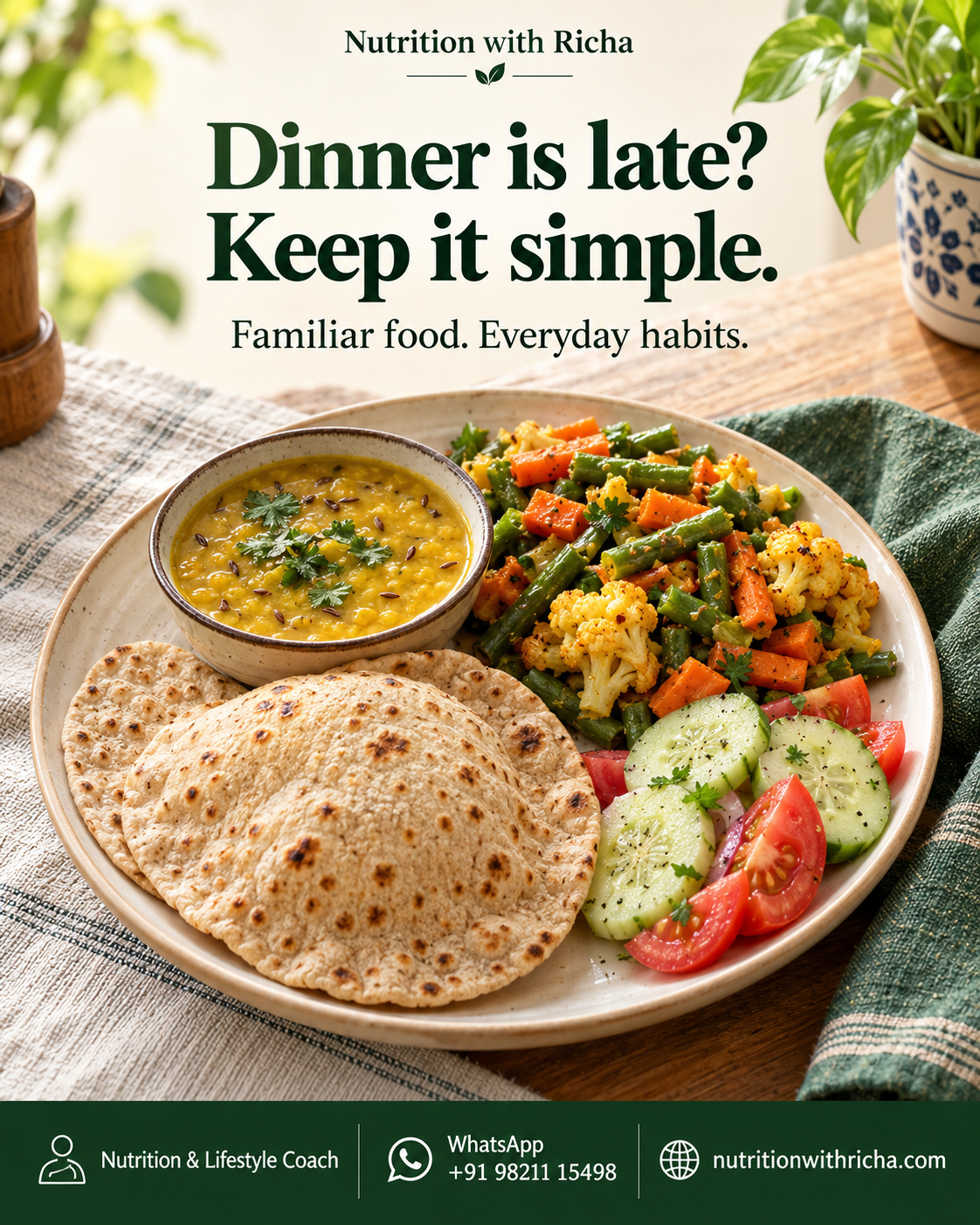
In many Indian homes, dinner is the last thing that happens before the lights go off. Someone reaches home after a long commute, the family waits so everyone can eat together, the rotis go on the tawa at 9:45, and by 10:30 everyone is in bed.
Waiting to eat together is a lovely habit. The trouble is what the late hour does to the evening around it: a long hungry stretch after lunch, a very large plate at the end of it, and little time between the last bite and sleep.
You do not need to give up a family dinner or eat alone at 7 pm. A few small changes to the evening usually help more than changing the menu.
1. Plan the bridge snack, so dinner is not your first meal in eight hours
If lunch is at 1:30 and dinner is at 10, that is a long gap. Most people fill it anyway, with whatever is in the packet. Planning it means you reach dinner hungry, not starving.
A small, filling snack around 5 to 6 pm works well: a bowl of curd, a whole fruit, a handful of roasted chana, a small bowl of thoroughly cooked sprouts or a glass of buttermilk. Keep it small. It is a bridge, not a fourth meal.
2. Keep the late plate balanced
A late dinner does not need to be a different meal. Keep your dal or pulse curry, or paneer, eggs, chicken or fish. Keep a sabzi. Add your roti or rice in the portion that suits you. Portions are individual: they depend on your age, how active you are, your health and your doctor's advice, so there is no one number of rotis that fits everyone. The NHS says the key to a healthy diet is eating the right amount for how active you are and a wide range of foods, with meals based on higher fibre starchy carbohydrates and lots of fruit and vegetables (NHS, Eight tips for healthy eating).
India's ICMR-NIN Dietary Guidelines suggest that vegetables, fruits, green leafy vegetables, tubers and roots make up about half the plate of what we eat in a day (Dietary Guidelines for Indians 2024, Guideline 1). A late dinner is a good place to lean on that half: a good bowl of sabzi or a simple salad next to your dal and your usual roti or rice.
If you want a picture of that plate, our balanced thali tool shows the idea. On very late nights, a bowl of vegetable moong dal khichdi with curd is a simple one-pot dinner.
3. Cook the base early
Late dinners often turn heavy because whoever cooks is also tired. Puri, parathas and takeaway are faster at 10 pm than dal and sabzi.
Move the slow work earlier. Pressure-cook the dal in the afternoon or while the evening snack is being made. Choose the vegetables for the sabzi earlier and store them whole as appropriate for each vegetable. At night, wash and chop the vegetables when you are ready to cook, using a chopper to save time if helpful, then temper the dal, cook the sabzi and make the rotis.
Keep make-ahead food safe:
- Refrigerate promptly. Once cooked dal, sabzi, rice or chopped vegetables are not being served or finished straight away, cover them and put them in the fridge. Cooked and perishable food should not sit at room temperature for more than two hours, or one hour when it is very hot (above 90° F, about 32° C) (US FDA, Are you storing food safely?). Divide a big pot into smaller, shallow containers so it cools quickly (USDA FSIS, Leftovers and food safety).
- Reheat thoroughly. Heat food until it is hot all the way through. USDA advice is to bring soups, sauces and gravies to a rolling boil, so treat dal and curries the same way, and cover and turn food in the microwave so it heats evenly (USDA FSIS, Leftovers and food safety).
4. Watch the side dishes that add up
Papad, pickle, namkeen on the side and an extra spoon of ghee all arrive quietly at a late dinner. Most of them add salt or fat rather than fullness. The WHO advises adults to keep salt below 5 grams a day (WHO healthy diet fact sheet), and ICMR-NIN asks us to restrict salt and limit foods high in fat, sugar and salt (Dietary Guidelines for Indians 2024, Guidelines 11 and 15). Choose one side you enjoy, not all of them.
5. Plan dinner around your sleep, not the other way round
Sleep guidance from the US National Institutes of Health suggests avoiding heavy or large meals within a few hours of bedtime, and says a light snack is fine (NHLBI, Healthy Sleep Habits). The NHS also notes that eating large meals close to bedtime may make it harder to fall asleep (NHS Every Mind Matters, sleep tips).
The same NIH guidance asks us to give ourselves enough time to sleep and to go to bed and wake up at the same time every day (NHLBI, Healthy Sleep Habits). So plan the evening so dinner fits before your usual bedtime, rather than cutting into the sleep you need. In real homes, a long gap is not always possible. Do what fits:
- If dinner cannot move earlier, keep it balanced and a comfortable size rather than a very large, heavy meal, and keep your usual bedtime.
- If the whole family can eat even 30 minutes earlier on some weeknights, start there. Cooking the base early (section 3) makes that easier.
- A short, easy walk after dinner, even around the house or the building, is a pleasant way to end the meal.
If you often get heartburn at night, the NHS lists not eating within 3 or 4 hours before bed among its self-help steps (NHS, Heartburn and acid reflux). Speak to your doctor if it happens often.
6. Move the last chai earlier
The 7 pm chai feels harmless when dinner is at 10. But tea, coffee and some soft drinks contain caffeine, and the NIH notes that the effects of caffeine can last up to 8 hours (NHLBI, Healthy Sleep Habits). If sleep is a struggle, try your last cup of chai or coffee earlier in the afternoon, and a warm glass of milk or a caffeine-free drink later if you want one.
7. Let children eat on their own clock
Younger children often cannot wait until 10 pm, and they do not have to. Serve them the same dal and sabzi earlier, and let them sit with the family later for a fruit or a glass of milk. One base meal, two serving times. If your household has several different needs, our family meal plan service builds one weekly menu around who eats what and when.
For Indian families abroad
Long commutes in Dubai, London, Toronto, Sydney or Singapore often push dinner just as late as in Gurugram or Mumbai. The same steps work with the Indian groceries you can find locally. Richa coaches online for Indian families abroad, by video or phone; see coaching for Indians abroad.
A word on your own needs
These are general everyday habits, not a plan for any medical condition. If you have diabetes, take medicines that affect blood sugar, work night shifts, are pregnant, or have food allergies or a doctor's advice about meal timing or particular foods, follow that advice first. Choose the snack and dinner foods that are safe for you; for example, swap curd or nuts for something else if you are allergic or intolerant.
Bring your evening to a consultation
If evenings are where your routine slips, bring a normal weeknight to a first consultation: what time you get home, who cooks and what time the lights go off. In 45 minutes we will choose two or three changes that fit your real evening. Coaching is online in English and Hindi. Book a consultation or say hello on WhatsApp.
Richa works alongside your doctor, not instead of them. Nutrition guidance does not replace medical care.
Sources
- ICMR-National Institute of Nutrition: Dietary Guidelines for Indians 2024.
- World Health Organization: Healthy diet.
- National Heart, Lung, and Blood Institute: Healthy Sleep Habits.
- NHS Every Mind Matters: How to fall asleep faster and sleep better.
- NHS: Heartburn and acid reflux.
- NHS: Eight tips for healthy eating.
- US Food and Drug Administration: Are You Storing Food Safely?.
- USDA Food Safety and Inspection Service: Leftovers and Food Safety.
Related information from Nutrition with Richa: coaching for Indians abroad, first consultation.